
A Path to Abundance
How emerging technologies may reduce scarcity-based bottlenecks

Future Tech and Reality
Many of the most important technologies now in development can be grouped around four fundamental aspects of reality: Energy, Matter, Time, and Space. These map closely onto the core inputs of the economy: Power, Resources, Intelligence, and Labour.
The relationships can be summarised:
Energy - Power
Time - Intelligence
Space - Labour
Matter - Resources

These are practical constraints that shape what an economy can produce and how.
The core claim is that sustained abundance across these four domains would remove many of the deepest bottlenecks in the economy, because all economic activity ultimately depends on some combination of power, resources, intelligence, and labour.
This does not imply instant utopia, or the end of politics, power, or conflict. But reducing scarcity at this level opens the possibility of an economy that is less dominated by constraint and more oriented toward human wellbeing.
What follows is an exploration of major emerging technologies, and how they may loosen the structural constraints that currently limit economic growth and social outcomes.
Emerging Technologies Overview
Energy: Power
Primary: Renewables
Secondary: Energy Storage
Tertiary: Nuclear- Advanced Fission/ Fusion
Time: Intelligence
Primary: AI
Secondary: Quantum computing
Tertiary: Distributed Systems and Blockchain
Space: Labour
Primary: AI Robotics
Secondary: Autonomous Vehicles
Tertiary: 3D Printing
Matter: Resources
Primary: Autonomous Mining/ Farming
Secondary: Nanotechnology
Tertiary: Asteroid Mining
Life: Self
Biotechnology
Intelligence: Neural Cybernetics
Energy: Lab-Grown Meat/ Food
Labour: Gene-Editing/CRISPR
Resources: Longevity Research
How These Technologies Are Assessed

Scalability
How easily a technology could be expanded to reduce scarcity across its domain.
Very High: Could fully meet demand in this domain
High: Could meet most demand
Medium: Could meaningfully supplement existing capacity
Low: Limited impact on overall scarcity
Very low: Negligible impact
Development
How close the technology is to widespread, practical use.
Very High: Commercially available
High: Near-term deployment
Medium: Active development
Low: In research
Very low: Long-term or speculative research
These ratings reflect technical and structural potential rather than precise economic or political forecasts. They are necessarily approximate, based on current public information and my best judgement.
Physical Economic Domains
The following sections examine the four physical economic domains: energy, intelligence, labour, and resources.
Energy: Power

Current limit: Modern economies still rely primarily on fossil fuels: coal, oil, and natural gas. These are constrained by geology, extraction rates, and geopolitical control, with a small number of countries able to influence global supply and prices.
Countries without significant fossil fuel reserves struggle to scale energy use, because supply is ultimately shaped by the incentives of exporting nations. Increased demand tends to raise prices rather than expand access, which is not a sustainable path to higher energy use.
Most importing countries benefit from abundant, cheap energy. Exporting countries, by contrast, often benefit from constrained supply and higher prices. This creates a structural mismatch of incentives.
Future potential:
Renewable energy allows generation infrastructure to be located in almost every country, bringing supply closer to demand and reducing exposure to global fuel markets. While renewables depend on minerals and rare earth elements, these are not consumed in use in the way fossil fuels are. The main bottleneck is extraction and processing capacity, which can be expanded and diversified geographically. This makes renewable energy structurally more secure over time.
Primary: Renewables
Pros: Cheaper, secure, scalable
Limits: Land and intermittency
While there are other renewable sources of power, such as hydro-electric, tidal and wave power, the two below seem to be more scalable.
Solar and Wind Power (Available)
Scalability: High
Development: Very High
Solar and wind are now cheaper than fossil fuels in many contexts.1 They are more resilient to geopolitical shocks and can be scaled rapidly, with current expansion limits driven mainly by land and sea use, which remain far from binding constraints.
Solar tends to be better in summer, and wind in winter, though both have the problem of non-constant energy supply. One common, and potentially cheapest, solution is to overbuild solar and wind above average energy requirements, then share power across large regions using transmission networks.23 This decreases the likelihood of overly low energy generation anywhere, and increases the minimum likely generated.
Geothermal (2030-2035)
Scalability: High
Development: Medium: In development for early 2030’s
Geothermal used to only be possible in certain areas where water was naturally heated by the molten earth underground. New techniques adapted from fracking and from laser technologies developed for fusion research may allow geothermal energy to be deployed in far more locations.4
While still in development, various projects aim to be running by the early 2030’s. This would allow for a constant, renewable, secure energy almost everywhere. And is also compatible with unused fossil fuel power generators.
Secondary: Energy Storage

Chemical Batteries (Available)
These are what we normally think of as batteries, such as lithium-ion batteries, and sodium-ion batteries. Typically best suited to short-term storage and grid balancing.
Lithium-ion Batteries: Higher density for electric cars, and some storage; but constrained by lithium supply.
Scalability: High
Development: Very High
Sodium-ion Batteries: Lower density, safer, and cheaper as sodium can be extracted from salt. It can also be used for electric cars, but would also be useful for large scale grid storage.
Scalability: High
Development: High
Redox Flow Batteries (2030-2035)
Scalability: High
Development: Medium
Redox Flow Batteries store energy in chemicals dissolved in liquid electrolytes, allowing for storage over the medium term.5
Physical Storage (2026-2030)
Pumped Hydro Storage: Using excess energy to pump water uphill, which flows back down again, spinning a turbine, when energy output is lower.
Scalability: Low
Development: Very High
Compressed Air Storage: Using excess energy to compress air into large caverns, allowing for a large storage of energy.
Scalability: Medium
Development: High
Hydrogen (2030-2035)
Scalability: High
Development: Medium
Primary long term storage for green energy.6 When energy output can be above need, excess is used to convert water into hydrogen and oxygen. Although less efficient than other storage options, hydrogen is valuable because it can store energy at large scale over long periods, and can power industrial processes that are difficult to electrify.
Green hydrogen (produced from green energy) is the main focus, but white hydrogen from drilling underground also exists.
Storage backups (Available)
Scalability: High
Development: Very High
A small, largely idle fleet of biomass plants or legacy gas power stations could be retained as emergency backup, particularly during the transition period.
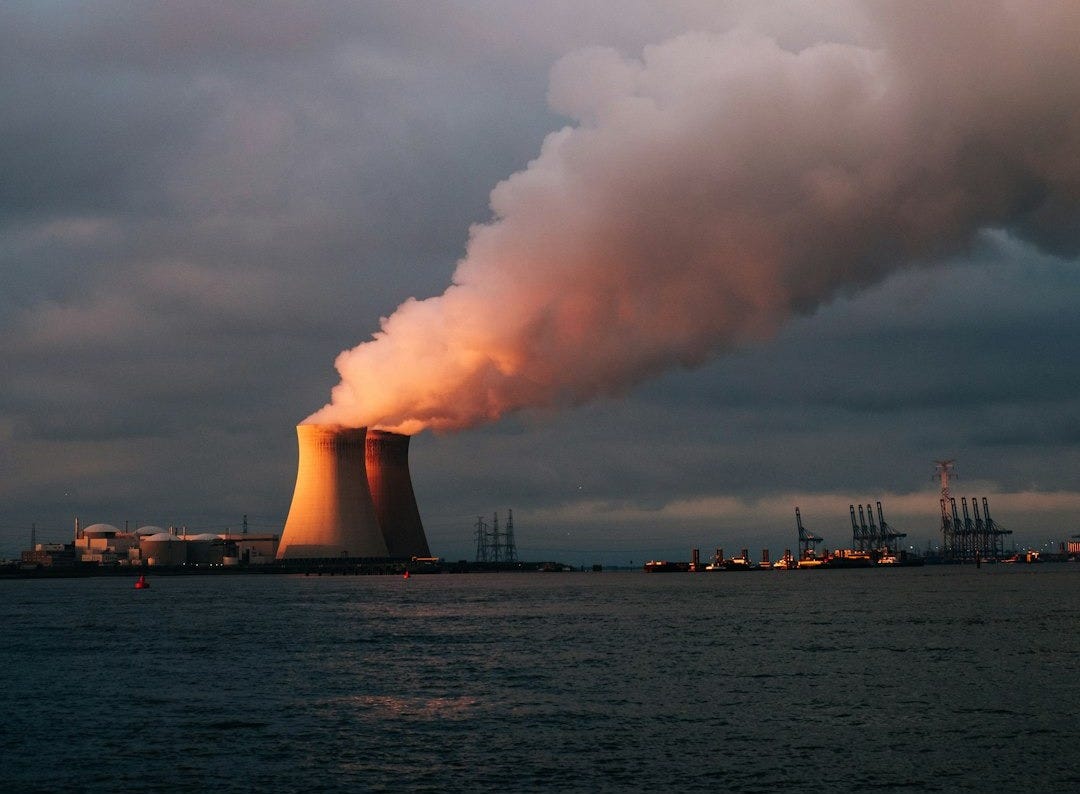
Tertiary: Nuclear - Next-Gen Fission & Fusion
Small Modular Reactors (2030-2035)
Scalability: High
Development: High
Smaller reactors built in factories, with the aim of reducing build time and cost. This allows sites to be gradually expanded as needed.78
Next Generation (IV) Fission (2030-2040)
Scalability: High but costly and slow
Development: Medium
The fourth generation of nuclear fission reactors aim to be safer, cheaper, and provide more energy; aiming for early plants in the early 2030’s.
Thorium and Salt Reactors (2030-2040)
Scalability: High
Development: Medium
A version of Gen IV fission. China plans the first one by 2029.
Fusion - Potential (2040-2050)
Scalability: Potentially Very High
Development: Low but promising
Creating power from fusing components from water and lithium, giving it high potential for cheap and unlimited energy, as both are common on Earth.
While still in development, more private companies have been started in recent years to attempt to commercialize fusion energy, suggesting accelerating progress, though still further off than most technologies mentioned here.9
Time - Intelligence

Purpose: Accelerate processes and expand cognitive and computational capabilities.
Current limit: Human intelligence, supported by classical computers, remains constrained by education, individual capacity, motivation, and population size. Expanding these resources is costly and slow.
Future Potential: Artificial intelligence could provide cheap, scalable cognitive labour. Quantum computers could tackle problems beyond classical computing, and may enhance AI when combined.
Primary: Artificial Intelligence (2028-2035)
Scalability: Very High
Development: High10
Currently, AI can answer complex questions beyond the average human in many domains.11 Development is underway to allow AI agents to handle routine cognitive tasks in computer-based work, with the potential for being generally useful in most knowledge work by 2028.
Secondary: Quantum Computing (2030-2035)
Scalability: Medium
Development: Medium
Quantum computers can solve problems that would be infeasible for classical machines, including chemistry, materials design, drug discovery, logistics, and AI training.1213
Tertiary: Distributed Systems and Blockchain (2026-2040)
Scalability: High
Development: Medium
These systems could enable new forms of digital governance, including blockchain-based voting informed by AI, potentially increasing participation and influence for ordinary citizens.
Space: Labour

Purpose: Expand physical capacity to move, manipulate, and produce resources.
Current limit: Human labour is constrained by population size, physical abilities, fatigue, and the cost of sustaining workers.
Future Potential: Mass production of low-cost physical labour through autonomous robotics, capable of continuous operation and standardized performance.
Primary: Androids & Autonomous Robotics (2030-2040)
Scalability: High
Development: Medium
Unlike traditional robots limited to pre-programmed tasks (e.g: assembly lines), a new generation of autonomous robots can act independently and perform precise operations without constant programming. Basic models are already in use, with generally capable versions expected by 2028, though mass production will take several additional years. 14
Secondary: Autonomous Vehicles (2030-2035)
Scalability: High
Development: High
Autonomous vehicles can reduce transport costs, free up commuting time, and lower traffic congestion and accidents. Drone delivery and flying cars are in experimental or limited commercial testing. Companies such as Waymo already operate autonomous taxis in select areas.1516
Tertiary: 3D Printing (2026-2040)
Scalability: Medium
Development: Medium
3D printing enables the fabrication of items directly from digital designs. It is already used in homes and businesses with plastics and metals, while ceramics, carbon-fiber composites, and concrete are in development for more advanced applications, including experimental housing.1718
Matter: Resources

Purpose: Supply and expand the availability of materials and resources for the economy.
Current limit: Material production is constrained by the availability of resources and human labour to extract and process them.
Future Potential: Automation can increase effective labour for resource extraction, while new technologies can expand the accessible supply of materials.
Primary: Autonomous Mining & Vertical Farming (2030-2040)
Scalability: Medium
Development: Low-Medium
Autonomous mining uses robotics with minimal human involvement, while vertical farming enables more efficient crop production in small areas. Autonomous mining has begun in limited locations in recent years.1920 Vertical farming is still developing, but progress is ongoing, as seen in projects like Dyson’s vertical farming initiatives.2122232425

Secondary: Nanotechnology (2035-2050)
Scalability: Medium-High
Development: Medium
Nanotechnology enables precise manipulation of materials at the molecular level, potentially creating new materials, improving manufacturing efficiency, and increasing resource utility. Real-world examples include carbon nanotubes and graphene, which are being used in advanced electronics, energy storage, and high-strength composites. While still largely in development, progress in laboratories and early commercial applications suggests broader use could emerge within the next few decades.
Futurists like Ray Kurzweil predict that by the 2030s nanobots operating at cellular scales could revolutionize medicine and materials, although this remains speculative relative to current laboratory and commercial uses.
Tertiary: Asteroid Mining (2050-2075)
Scalability: High
Development: Very Low
Asteroid mining could provide materials by extracting resources in space and transferring them to Earth or orbital factories. Using orbital space, the Moon, and eventually Mars would expand available space for economic activity. The field is in very early stages, with experimental projects exploring asteroid landing, drilling, and resource extraction.
Reinforcement Cycles
As these technologies mature, they begin to reinforce one another, creating feedback loops that progressively reduce economic constraints:
• Robotics accelerates mining, manufacturing, and construction.
• Autonomous mining supplies materials for more energy infrastructure and machines.
• AI coordinates systems and accelerates the design of all other technologies.
This creates accelerating and compounding effects, where progress in one domain lowers constraints across the others.
Unlike other domains, Life: Self relates directly to humans, modifying what individuals can expect from their own biology.
Life: Self

As material scarcity declines, ethical questions about how life is lived, rather than how goods are produced, become increasingly central.
The economy has always been oriented toward meeting human needs, but under conditions of scarcity this has required indirect methods: maximizing output, allocating limited resources, and prioritizing trade-offs. As abundance increases, human needs can be addressed more directly, with less emphasis on managing scarcity and more on improving lived experience itself.
Biotechnology
Biotechnology is distinctive because it acts directly on the human organism, addressing health, longevity, and experience without first passing through traditional economic constraints.
Purpose: Expand health, autonomy, and experience.
Current limit: Nature at the expense of human wellbeing, limiting health span, physical and cognitive performance, and resilience to disease.
New Potential: Enabling direct intervention in biological processes, allowing human capabilities and longevity to be improved rather than merely supported by external tools.
Energy: Lab-Grown Food (2030-2040)
Lab-grown food uses stem cells to produce meat without the need for raising and slaughtering whole animals.26
This uses less resources and land, potentially allowing more of nature to be protected or rewilded. It also reduces the need for animal suffering in food production, separating wellbeing from ecological harm.
Intelligence: Neural Cybernetics (2035-2050)
Brain–computer interfaces could enhance human mental capabilities through direct integration with technology.27 This may help preserve human agency as AI becomes more intelligent, while also expanding the range of possible experience through advanced virtual reality.
Labour: Gene-Editing (2026-2040)
Using techniques such as CRISPR to edit genes to treat or cure inherited diseases, reducing involuntary suffering and increasing individual autonomy. Early gene-editing therapies are already being approved or trialled for specific conditions, with wider applications likely to emerge gradually as safety, precision, and ethical standards improve.282930
Resources: Longevity Research (2040-2050)
Research aimed at extending healthspan rather than simply lifespan, by slowing, repairing, or reversing biological processes associated with aging.31 Current work focuses on cellular repair, senescence, and metabolic regulation, and remains largely experimental, with meaningful population-level impact likely only in the longer term.
Self: As artificial intelligence surpasses humans in many cognitive domains, biotechnology becomes less about competing with machines and more about preserving human agency, individuality, and meaningful experience.
Biotechnology is less about building a more powerful economy and more about defining what kind of lives an abundant economy should enable.
Conclusion

Renewable and green energy, artificial intelligence, autonomous robotics, and advanced resource creation and extraction appear set to converge shortly after 2030, making way for a future of abundance, with higher standards of living for all, rather than scarcity. This has high potential to shift the state of economics, work, society, and politics to something new.
As artificial intelligence increasingly handles technical and logistical questions, the more difficult challenge becomes deciding which outcomes are worth pursuing and how economics should serve human needs. Technologies that shape human society bring value questions about freedom, equality, and wellbeing to the foreground. What is a good life and good society?
The hope is not to transcend humanity, but to allow people to live full human lives with fewer involuntary limits, focusing on wellbeing, creativity, and meaningful social connections.
In a future post, I will explore how societies could organise economically and politically to maximise wellbeing in an era of abundance.
https://www.ox.ac.uk/news/2022-09-14-decarbonising-energy-system-2050-could-save-trillions-oxford-study
https://trellis.net/article/radical-idea-get-high-renewable-electric-grid-build-way-more-solar-and-wind-needed/
https://100percentrenewableuk.org/one-months-worth-of-storage-needed-for-100-per-cent-re-system-in-uk-says-study
https://www.quaise.com/
https://www.sciencedirect.com/topics/engineering/redox-flow-battery
https://www.irena.org/Publications/2025/Jun/Analysis-of-the-potential-for-green-hydrogen-and-related-commodities-trade
https://climateinsider.com/wp-content/uploads/2025/05/ClimateInsider_SMR_Commercial_Readiness_MarketReport.pdf
https://www2.itif.org/2025-small-modular-reactors.pdf
https://www.peaknano.com/blog/the-state-of-the-fusion-energy-industry-in-2025
https://www.nature.com/articles/s41586-024-07487-w
https://hai.stanford.edu/ai-index/2025-ai-index-report
https://thequantuminsider.com/2025/05/16/quantum-computing-roadmaps-a-look-at-the-maps-and-predictions-of-major-quantum-players/
https://www.pasqal.com/solutions/hardware/
https://www.bain.com/insights/humanoid-robots-from-demos-to-deployment-technology-report-2025/
https://reports.weforum.org/docs/WEF_Autonomous_Vehicles_2025.pdf
https://fifthlevelconsulting.com/top-10-autonomous-vehicle-trends-2025/
https://triangleip.com/3d-printing-innovations/
https://amfg.ai/2025/03/10/5-exciting-innovations-in-3d-printers/
https://www.automate.org/robotics/editorials/the-rise-of-autonomous-mining-trucks-and-robots
https://www.mining-technology.com/analyst-comment/china-global-leader-autonomous-surface-mining-trucks/?cf-view
https://www.archivemarketresearch.com/reports/vertical-farming-technology-278646
https://agrinextcon.com/top-10-vertical-farming-trends-reshaping-the-future-of-food/
Fertilizer by plasma: https://ukagritechcentre.com/news/plasma-technology-agriculture/
Fertilizer by gene editing: https://www.tsnf.org.uk/biological-nitrogen-fixation/
Fertilizer by electrolysis: https://phys.org/news/2025-10-pulsed-electrolysis-harvest-nitrogen-air.html
https://euromeatnews.com/Article-Lab-grown-meat-market-to-value-$25-billion-in-10-years/4819
https://www.forbes.com/sites/chuckbrooks/2025/04/20/the-meshing-of-minds-and-machines-has-arrived/
https://crisprmedicinenews.com/clinical-trials/
https://www.chop.edu/news/worlds-first-patient-treated-personalized-crispr-gene-editing-therapy-childrens-hospital
https://med.stanford.edu/news/all-news/2025/09/ai-crispr-gene-therapy.html
https://www.timeline.com/blog/2025-breakthroughs-in-longevity-research